Borthwick Castle: Turner, Le Keux, and a Photogravure Across Two Centuries
Updated: May 10
I recently attended a wedding celebration at Borthwick Castle, just outside Edinburgh. It was one of those rare occasions when place, history, weather and atmosphere seemed to arrange themselves without effort. The castle stood above the landscape with quiet authority, ancient stone, restless sky, trees moving in the wind, and horses grazing below.
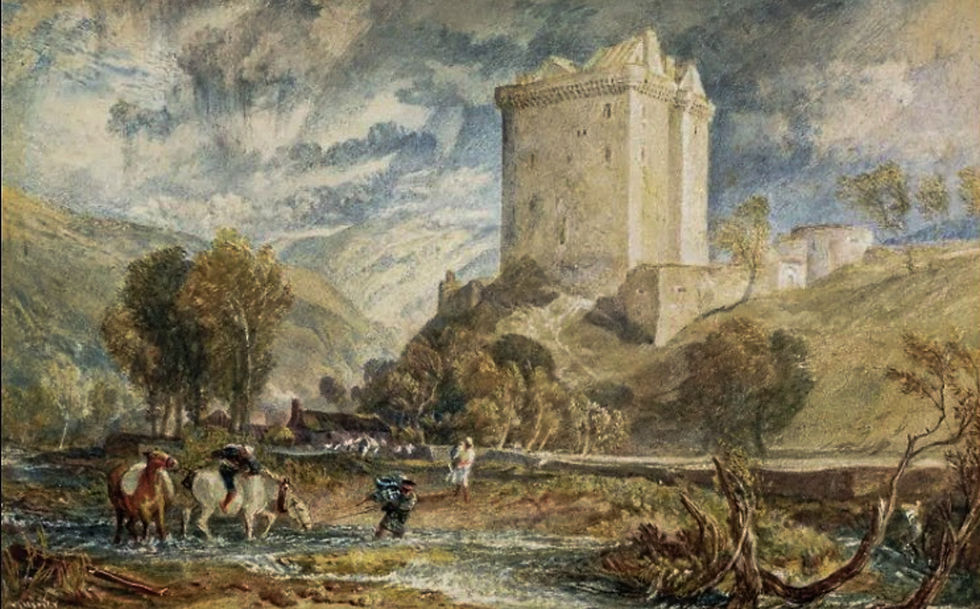
Borthwick Castle is not merely picturesque. Built in the fifteenth century, it is one of Scotland’s great fortified tower castles, a place shaped by defence, status and political intrigue. Mary, Queen of Scots, sought refuge there in 1567 with the Earl of Bothwell, shortly before her forced surrender at Carberry Hill. Almost a century later, in 1650, Oliver Cromwell’s forces besieged the castle, leaving their mark on its walls. To stand before it today is therefore to see more than a romantic silhouette in the landscape; it is to look at a structure that has witnessed monarchy, conflict, siege and survival.
On one of the days, an escape from the busy wedding celebrations, I went for a walk and took a photograph with my iPhone. It was not a carefully planned image, but simply a moment seen and taken, the castle rising in the distance, the darkened trees beneath it, a pale horse in the foreground, and the unsettled Scottish sky above.
Later, while speaking with one of the wedding guests, I was told that J. M. W. Turner had painted Borthwick Castle in 1818. An engraved version of Turner’s image was then made by Henry Le Keux in 1819. When I looked at both works, I was struck by the unexpected resemblance between Turner’s perspective and my own.

The elements were almost uncannily familiar: the same castle, the same dramatic sky, the same relationship between architecture and landscape, and the same presence of trees and horses. My photograph had not been made in reference to Turner or Le Keux. I had not known either work existed. Yet standing in that place, looking across that terrain, I had found myself drawn to the same composition that captured Turner’s attention more than two hundred years earlier.
There is something quietly moving in that. A landscape can change greatly over two centuries, yet certain arrangements endure. A castle still commands the hill. Weather still gathers around it. Horses still graze beneath its walls. The eye, too, may be pulled by the same forces: mass, light, distance, atmosphere, and the tension between human construction and the natural world.
The iPhone photograph was not technically ideal. It carried the limitations one would expect from a small digital file made casually during a walk. But the image had a presence that interested me. Rather than discard it, I began to wonder whether it could be carried into another medium — one slower, more tactile, and closer in spirit to the old engraved image than to the instantaneous digital photograph.
When I returned home, I began to work on the image and used it to make a photogravure plate. Photogravure, or photo-etching, translates a photographic image into an etched plate, which can then be inked, wiped and printed by hand. It is not simply a reproduction technique. It alters the image, giving it grain, depth, pressure, tone and physicality. The print becomes an object rather than only an image.
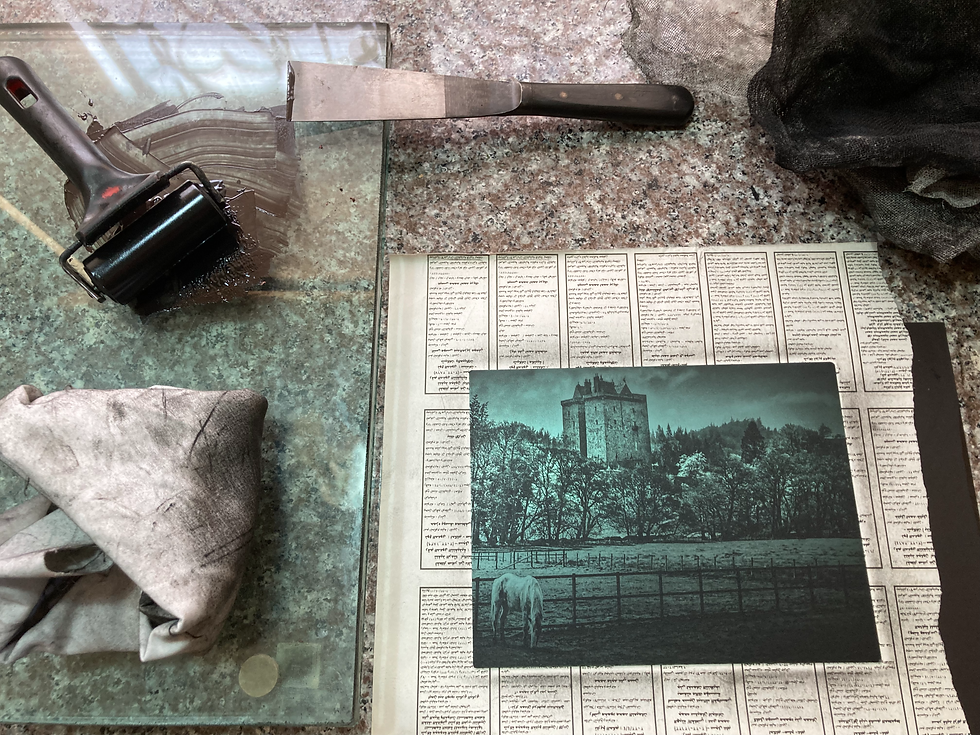
The process involved test plates, calibration, tonal adjustments and several printed trials. What began as an unimpressive phone photograph slowly passed through a chain of transformations: from digital image to etched plate, from plate to ink, from ink to dampened paper. Each stage introduced its own interpretation.
In that sense, the work entered into a quiet conversation with Turner and Le Keux. Turner’s 1818 painting was translated into an engraved image in 1819. My own photograph, made more than two centuries later, was translated into a photogravure print. In both cases, Borthwick Castle moved from direct observation into another material language.
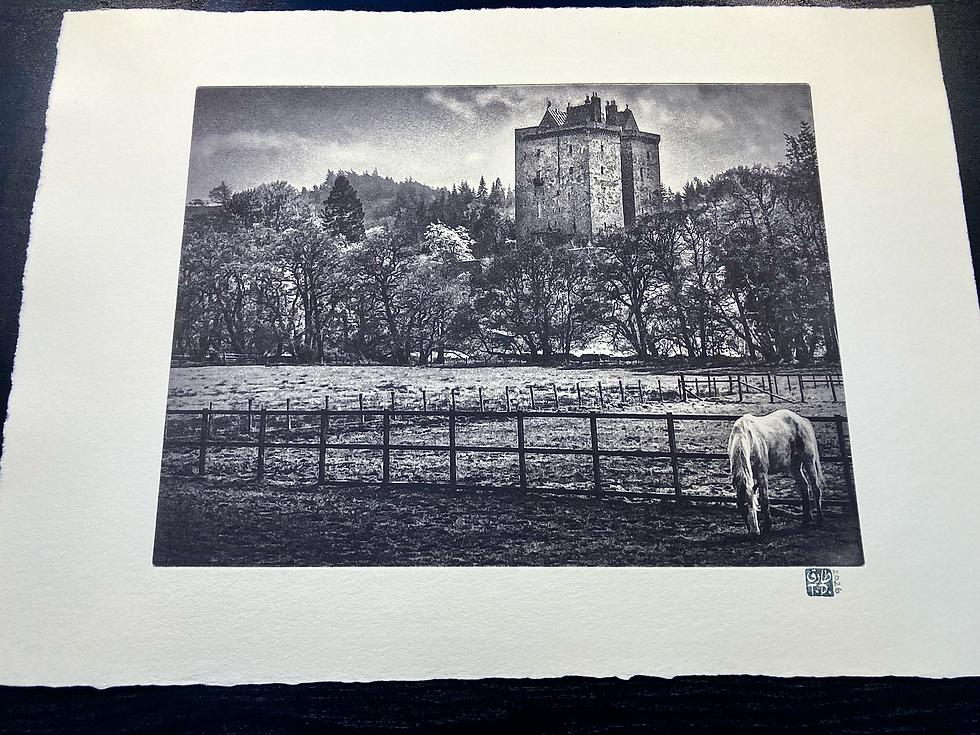
The final print is not intended as an imitation of Turner, nor as a documentary record of the castle. It is more a small meditation on recurrence: how a place can hold an image within it, waiting to be seen again; how different people, at different times, may be caught by similar arrangements of light, weather and form; and how an image can move between media while retaining something of its original atmosphere.
What I found compelling was not only the resemblance between the images, but the way the story unfolded backwards. I first made the photograph, then discovered Turner, then returned to my own image through the ancient process of photogravure. The result felt less like a copy than a crossing of paths: an accidental encounter between a wedding walk, a nineteenth-century master, a phone camera, an engraved plate, and a hand-pulled print.
Borthwick Castle has stood for centuries. Turner saw it in 1818. Le Keux engraved it in 1819. I photographed it more than two hundred years later, almost by chance, etched it into a plate and made a new print of an ancient landscape.
The castle remains. The weather changes. The horses come and go. The image returns. And a story continues, connecting us to what was there before...


Comments